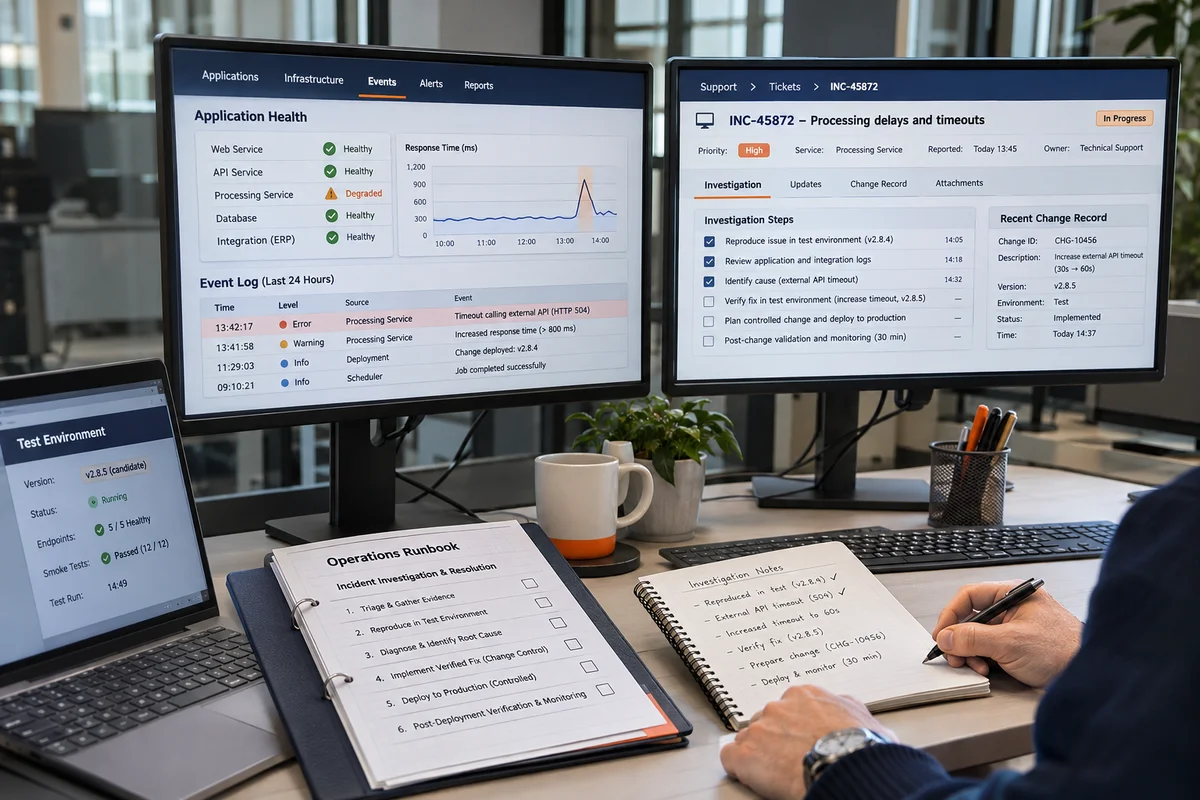
Investigate the fault, protect the workflow and make the change reviewable.
Live software and integrations need more than occasional fixes. Your team needs to understand what failed, which users or processes are affected and how a change will be verified. We provide website, application and integration support with an agreed scope, a clear investigation process and a usable record of the work.
Where projects get stuck.
The team has a symptom but no clear diagnosis
A failed report, stale dashboard or missing device event may involve several systems. We gather examples, check the relevant components and narrow down where the workflow diverges from its expected behaviour.
Changes fix one screen and break another process
An application or interface change can affect permissions, reporting and connected systems. We plan validation around the affected workflow rather than checking only that the error message disappeared.
Support depends on knowledge that is not documented
Deployment steps, credentials, dependencies and prior changes may be known by one person. We review the available information and improve the handover needed to maintain the agreed system.
What we support and improve.
Website and application maintenance
Investigate issues, update agreed components and implement defined enhancements. Review deployment and content dependencies before changing a live site or application.
Integration troubleshooting
Trace exchanges across the relevant application, middleware and device/platform boundary. Review payloads, logs, identifiers and connection status to isolate the failure.
Controlled improvements
Turn a support finding into a scoped fix or enhancement with clear acceptance checks. Agree change windows, validation and recovery arrangements for the system involved.
Technical review and documentation
Review the code, deployment and operating information available. Document configuration, dependencies, changes and practical support procedures within the agreed engagement.
A dashboard stops updating after a connected platform changes.
- Starting point
- Operators still see the application, but new events or records are missing. The cause could be an interface, credential, data-mapping or processing change rather than a broken dashboard screen.
- Our approach
- We reproduce the issue with representative records, inspect the exchange and identify where processing fails. The fix is checked against successful, failed and repeated events before release.
- What improves
- The team receives a verified change and an explanation of the affected dependency. The investigation and operating notes provide a better basis for handling a similar issue later.
Work that informs our approach.
Vkwebtech’s software and integration work spans PSIM, attendance, access control and RMS web/mobile delivery. That cross-system perspective matters when a support issue sits between an application and the hardware or platform it depends on. Support coverage and response arrangements are agreed per engagement.
How we deliver the work.
- 01
Establish the support boundary
Review ownership, access, deployment, known issues and the systems covered by the engagement.
- 02
Triage and reproduce
Assess business impact, collect useful examples and confirm the failure before choosing a remedy.
- 03
Resolve and validate
Implement the agreed change in an appropriate environment and check the affected workflow and dependencies.
- 04
Release and record
Coordinate the change, confirm the outcome with the team and document the work and remaining actions.
What you receive.
- Agreed coverage and prioritisation process
- Investigation findings and defined fixes/enhancements
- Relevant validation and release notes
- Updated technical or operational guidance within scope
What helps us scope it.
- System ownership, source and deployment information
- Examples of the issue and its business impact
- Authorised access to relevant applications and logs
- Your support window, priorities and change approval process
Questions about this service.
Do you support software developed by another team?
We can review its condition, source availability, deployment and dependencies before agreeing support. An initial technical review helps establish a realistic scope and identify missing access or documentation.
Is ongoing support the same as new feature development?
Fault investigation and maintenance differ from a new feature or substantial workflow change. We identify that distinction during triage and agree scope and acceptance checks for enhancements.
How are support coverage and response arrangements agreed?
We review business priorities, covered applications, operating windows and escalation responsibilities during onboarding. Coverage and response arrangements are then recorded in the engagement alongside the change approval process.