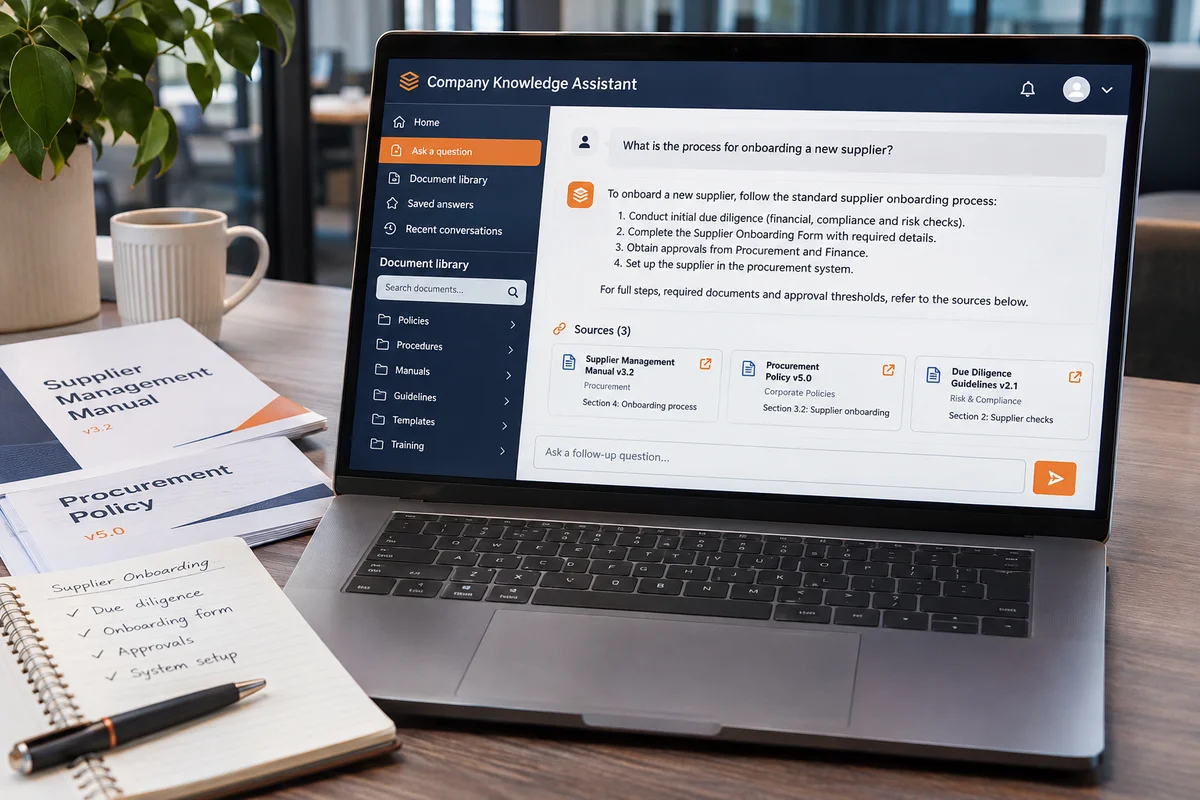
Make company knowledge useful—and keep actions under control.
An AI assistant is valuable when it helps a person complete a real task with the right information. We scope company knowledge assistants, retrieval-augmented generation (RAG) and workflow agents around permitted data, useful sources, measurable test cases and clear human review. The starting point is the job to be done, not a chatbot widget.
Where projects get stuck.
Staff cannot find the current answer
Policies, manuals and working knowledge are scattered across documents. We review the sources, identify authoritative versions and design retrieval around the questions people actually ask.
An answer sounds convincing but cannot be checked
A fluent response is not enough for a business decision. We build source references and evaluation cases into the workflow, including questions the available information cannot answer.
Automation can act beyond what the business intended
A tool-connected agent needs defined permissions and approval points. We separate finding information from changing records or taking an action, and agree where a person must confirm the next step.
What we build for useful business AI.
Company knowledge and RAG assistants
Prepare approved sources, retrieval and answer presentation for the selected use case. Include source references so users can inspect the information behind a response.
Document ingestion and information boundaries
Review file quality, document structure, updates and source ownership. Plan how access permissions and document changes should affect what an assistant can retrieve.
Agents connected to approved tools
Connect the agreed business APIs or tools for a defined workflow. Set action boundaries, input checks and human approval where the task warrants it.
Evaluation and operational review
Test realistic questions, missing or conflicting sources, access boundaries and tool failures. Define how uncertain answers, errors and escalations should reach a person.
Staff repeatedly ask for information already buried in company procedure documents.
- Starting point
- People search multiple folders or ask a colleague because they do not know which document is current. A generic AI chat cannot reliably explain where an answer came from.
- Our approach
- We select an approved document set, prepare retrieval and build an assistant that answers the agreed question types with source references. We evaluate representative questions, unanswered questions and information-access boundaries.
- What improves
- Staff have a focused way to find and check the relevant information. Expansion to other documents or tool-driven actions follows evaluation of the first use case rather than an uncontrolled rollout.
Work that informs our approach.
AI, RAG and business agents are offered as scoped development services. Vkwebtech’s wider custom-software and integration work provides the application and interface context needed to connect an assistant with business workflows. A focused, evaluated first release is the practical starting point.
How we deliver the work.
- 01
Choose one useful job
Define the users, recurring task, permitted information and what a good answer or action should look like.
- 02
Prepare the information flow
Review source quality, document updates, retrieval design, access boundaries and the interface users need.
- 03
Prototype and evaluate
Test against representative questions and failure cases. Review source quality, answer usefulness and any proposed tool actions.
- 04
Deploy with ownership
Agree monitoring, feedback, source updates and human escalation so the workflow can be maintained after launch.
What you receive.
- Defined use case and permitted data/tool scope
- Working retrieval/assistant or agent workflow
- Evaluation cases and reviewed limitations
- Operating guidance for sources, feedback and escalation
What helps us scope it.
- The specific task and users you want to help
- Approved source documents and ownership/access rules
- Examples of useful questions or proposed tool actions
- A reviewer who can assess answer quality and approve boundaries
Questions about this service.
What is the difference between RAG and an agent?
RAG retrieves relevant information to help produce an answer, often with sources. An agent can also use tools to take steps in a workflow. We scope those responsibilities separately because their permissions and failure cases differ.
Can the assistant use private company documents?
That can be scoped with the organisation’s approval. Source access, user permissions, processing arrangements and the intended deployment must be agreed before documents are connected.
How do you judge whether it works?
We define representative questions or tasks and review the outputs against expected evidence and behaviour. The evaluation includes incorrect, missing and out-of-scope information, not just successful demonstrations.